Phone
Missed Calls in a Tree Service: What They Cost and How to Stop Them
Missed calls in a tree service: how to count what they cost from your own call log, ways to catch every call, what a good answer sounds like, and what the texting rules say.
 TreePilot7 min read
In this article
A missed call in a tree service is a job you never got to price, and you can count what it costs from three numbers: how many calls you miss, what share would have become jobs, and what a job leaves you. On the round example numbers in this guide, a job like our dead oak leaves $471.32. If you miss 20 calls a month and one in ten would have booked a job like that, you lose two jobs and $942.64 a month, about $11,300 a year. Those are examples. Count your own missed calls for one week before you spend anything on a fix: your phone already has the number.
The dollar figures are examples built on how much to charge for tree removal, where the $471.32 is worked out. The one-in-ten is an assumption to show the sum, not a rate we measured. This guide is for the United States. Rules on texts and on recording calls differ by state, and nothing here is legal advice.
Why tree companies miss calls
Tree work is a hard trade for answering the phone, for plain reasons:
- You are working. Nobody takes a call at the top of a tree, and with a chipper or a saw running you cannot hear it.
- Storms. The calls come at night, all at once, after the wind stops.
- Evenings. People call after work, when you are doing paperwork or asleep.
- Language. A caller who prefers Spanish or Portuguese may hang up when nobody can help them in it.
Safety comes first, and the phone waits. The answer is not to answer in the tree. It is to have something else answer.
What does one missed call cost?
A missed call is worth what a job leaves you times the chance it would have become one. The pricing guide's dead oak, with the stump ground and the wood hauled, is quoted at $1,880 and leaves you $471.32. Use your own figure from your pricing sheet. The table shows what the share does to a month, on 20 missed calls:
| Share of missed calls that would have booked | Jobs lost a month | Left after all costs a month | A year |
|---|---|---|---|
| 1 in 20 | 1 | $471.32 | $5,655.84 |
| 1 in 10 | 2 | $942.64 | $11,311.68 |
| 1 in 5 | 4 | $1,885.28 | $22,623.36 |
Tree jobs differ, and a stump is not an oak. The point is the method: missed calls x the share that would have booked x what a job leaves you. It does not matter which row is yours until you find out.
Step 1: count your own missed calls for one week
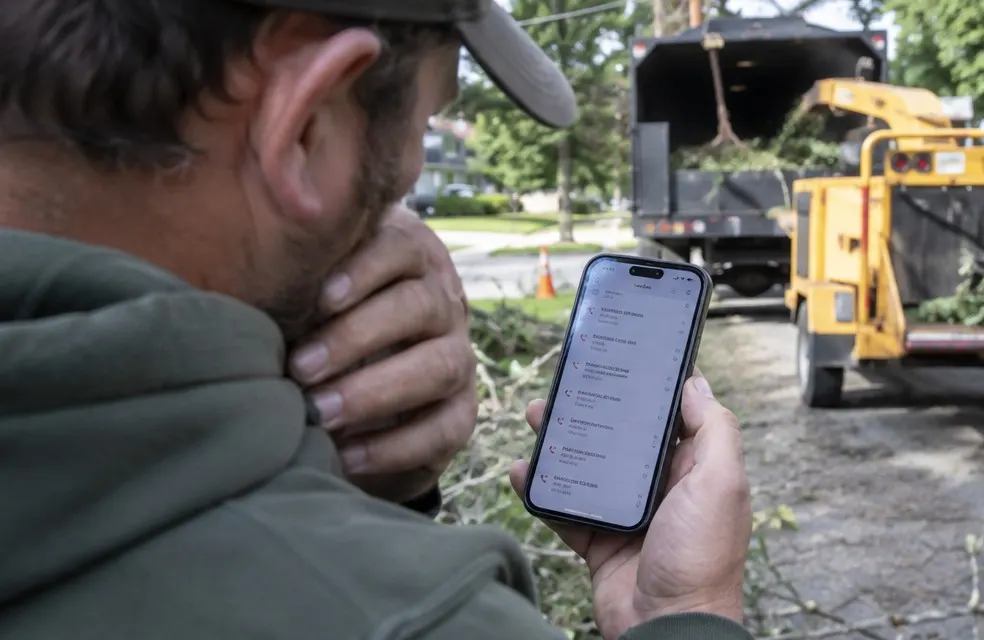
For seven days write down every call you did not pick up. Your phone's call log has the time and the number. You need these columns:
| Day and time | Number | Did they leave a message? | Did you call back, and when? |
|---|---|---|---|
| Tuesday 10:40 | (the number) | No | Yes, 1:15 pm |
At the end of the week count the calls, the messages, and the callbacks. Then call back the numbers that did not leave a message and ask whether they still need someone. The share who say yes and book is your number, not ours. It might be one in two or one in twenty, and a made-up one would not help you decide.
Step 2: choose how the call gets caught
| Way | What it does | What to find out before you pay |
|---|---|---|
| A greeting with a number to text | Tells the caller you are on a job and how to reach you | Nothing to pay, but the caller has to act again |
| A family member or partner | Answers and takes a message | Can they quote your range? Are they free in storm season? |
| A human answering service | Takes a message in the voice of your company | The monthly price in writing, per call or flat, and what happens after hours |
| A text back to a missed call | Sends a message from your business number | How the caller agrees to texts, and how they stop them (see below) |
| An AI receptionist | Answers, quotes from your prices, takes the address, texts you a summary | What it quotes, what it cannot do, and the price per month |
We do not print what other services cost. Prices change and differ by company, so ask for one in writing. Then do this test: divide the monthly price by $471.32. A $100 service, an example figure, has to bring or save about 0.21 of a job a month to pay for itself, which is about one job every five months. Your own numbers give your own answer.
What does a good answer sound like?
The caller wants a person who answers, a range and a next step. In the owner's voice:
"Thanks for calling Canopy Tree Care. For a dead oak that size next to the house, with the stump ground and the wood hauled, a job like this usually runs between $1,800 and $2,000, and I confirm it when I see the access. What is the address, and is Thursday afternoon good for a visit?"
If you cannot pick up, a text back should say the same in two lines:
"Hi, this is Dan from Canopy Tree Care. Sorry I missed your call, I am on a job. What do you need done, and what is the address? Reply STOP and I will not text again."
If the caller says a tree is on or near a power line, the answer is different. Tell them to stay away from the tree and anything touching it, and to call the utility; if anyone is hurt, call 911. OSHA's Electricity and Tree Care Work says to assume that all lines are energized at all times, and that applies to a homeowner on the phone as much as to a climber.
What do the rules say about texting people back?
The FCC says its rules ban text messages sent to a mobile phone using an autodialer unless the phone owner previously gave consent to receive the message or the message is sent for emergency purposes. The same page says that commercial texts require written consent, while for informational texts consent may be oral. A text that quotes a price may be treated as commercial, so plan for written consent. It also says that you may opt out of any robocall or robotext at any time and in any reasonable manner, even if you previously gave consent for such calls. So: put plain-words consent on your quote form, honor "stop" however it is written, and ask a lawyer how your state treats a text to someone who just called you.
Recording a call is a state question. If your answering tool records or transcribes, tell callers at the start and check what your state requires.
What an AI receptionist for a tree service does
The TreePilot answering service is an AI receptionist. It answers your business line with your company name, day and night. On the page where we describe it:
- It quotes from your own calculator: per tree, by height, with stump grinding or haul-away
- On storm calls it asks whether anyone is hurt and whether a line is down, tells the caller to call 911 or the power company if so, and takes the address and what the tree hit
- It texts you a summary, so you can call back at first light or sooner
- It books the estimate visit on your calendar if you allow it
- It switches to Spanish or Portuguese when the caller does
It does not replace you, and it does not promise that a crew will come tonight unless you tell it to: by default it gives your emergency range, takes the details and says you will call back. It does not climb, cut or decide who goes first. You still call back, see the tree and quote it.
After hours and storm nights
The calls that pay the most come in a burst after a storm. Count that night separately: how many calls came between midnight and 7 a.m., how many reached a person, how many left a message and how many you booked. The next storm you will know what that night is worth. The hurricane season guide shows how to plan the rest of the season, including what to say and how to price emergency work.
Other habits that cut missed calls
- Return texts fast. "I am on a job, I will call at 12" is better than silence.
- Put a range on your website, so fewer people need to call to ask. See tree service estimates that close.
- Keep your Google hours true. If you say you answer at night, someone should. See Google Business Profile for tree service.
- Let customers book the visit online. The scheduling software lets them pick a slot on the days and towns you choose.
How to know it pays
Repeat the one-week count after a month with the fix in place. Compare calls reached, jobs booked and the monthly price against the $471.32 test above. If the jobs it brought do not cover the price, change something or stop. For the other ways to get customers, and how much to pay for a lead, read how to get tree service customers.
Frequently asked questions
How many calls does a tree service miss?
We have no source for an average, so count yours: write down every call you do not answer for one week. Then multiply the missed calls by the share that would have booked and by what a job leaves you, $471.32 on the guide's example numbers.
Can an AI receptionist give tree service prices?
It quotes only from the prices you set in your calculator, as a range, and texts you the details so you can confirm. By default it does not promise that a crew will come tonight.
Can I text back someone who called and did not leave a message?
The FCC says its rules ban texts sent with an autodialer unless the phone owner gave consent, that commercial texts need written consent, and that people can opt out of robotexts at any time in any reasonable manner. Get consent on your forms, honor a stop request and ask a lawyer about your state.